
By: Scott Harris
I haven’t been the target of a deepfake myself, at least not that I know of. It’s still one of the things that keeps me up at night.
A few friends have told me about people they know who got calls from what sounded like a child or grandchild in trouble, urgently asking for money, and who went out and bought cash cards to help. I’ve watched the same news stories everyone has about political and celebrity deepfakes. The one that hit closest to home, though, involved a friend’s teenage daughter. She thought she was talking with a modeling agent and was pressured into sending pictures. None of it was real; the “agent” was someone else entirely. When police confronted him, he made a fake dating profile in her name and fabricated messages to make it look like she had pursued him. The original conversations had been in an app that kept no history, so for a while it was her word, and her best friend’s, against his. If investigators hadn’t found where he’d posted the pictures, he might have gotten away with it.
That’s what identity manipulation looks like when it lands on an ordinary family.
What a deepfake is, and why it works
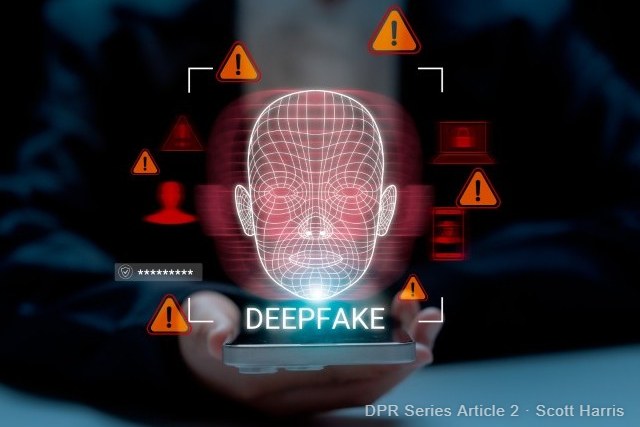
Deepfakes are AI-generated media built to convincingly imitate real people. Machine learning models are trained on someone’s images, video, and audio until they can produce new content that looks and sounds authentic, often good enough that the average person can’t tell the difference.
The technology has legitimate uses in film, entertainment, and digital media. But the ability to copy and manipulate a human identity at scale is no longer theoretical. Criminals have already used AI-generated voices to impersonate executives and family members, pressuring people into sending money or sharing sensitive information. Fabricated videos have been used to spread misinformation, sway public opinion, and damage reputations.
The ugliest use, and who it hits
One of the fastest-growing kinds of misuse is non-consensual pornography. In 2019, Deeptrace Labs estimated that about 96 percent of deepfake videos online were pornographic, and the vast majority targeted women. More recent industry analyses show the same pattern, so this isn’t a passing problem.
Many of the best-known victims are public figures. Scarlett Johansson has often been cited as one of the most frequently targeted people in deepfake pornography, and even people who died long ago, like Marilyn Monroe, have shown up in AI-generated content without anyone’s consent, which raises its own questions about identity rights after death.
Focusing only on celebrities misses the bigger picture, though. For private people, the damage can be even worse. Cases involving ordinary people are increasingly tied to harassment, bullying, and revenge, and victims run into real barriers when they try to fight back: the cost of a lawyer, how hard it is to get content taken down, and how fast it spreads. Even a badly made deepfake can do real harm. Its mere existence can cause emotional distress, damage a reputation, and follow someone personally and professionally for years.
It’s going to get easier, not harder
This problem is likely to grow. Our digital footprints keep getting bigger, and with them the supply of photos, videos, and voice recordings anyone can find. Social media alone holds billions of images that could be used to train AI. Meanwhile, the tools to make deepfakes keep getting easier to use, needing less skill and less source material every year.
So here’s the question I keep coming back to: should people have legal rights over the digital replication of their own likeness?
Today’s legal tools, like privacy law, defamation law, and the right of publicity, weren’t built for a world where someone’s identity can be synthetically recreated, edited, and distributed at scale without their knowledge. My friend’s daughter is proof of how thin that protection can be.
That’s where Digital Persona Rights come in. They would extend identity protection into the AI era by recognizing that your likeness, your voice, and your behavior are core parts of who you are, and that you deserve clear ownership and control over them. Without that, all of us become more vulnerable in a digital world where authenticity is harder to verify and misuse is easier to pull off.
Deepfakes are only one piece, though. Behind every convincing fake is a growing pile of personal data: digital footprints and biometric details that can be used to model, predict, and copy how we behave. In the next post, I’ll look at how that data collection complicates the question even further, and why control over your personal data may matter just as much as control over your face.
Join the conversation