
Help, I’m being kidnapped
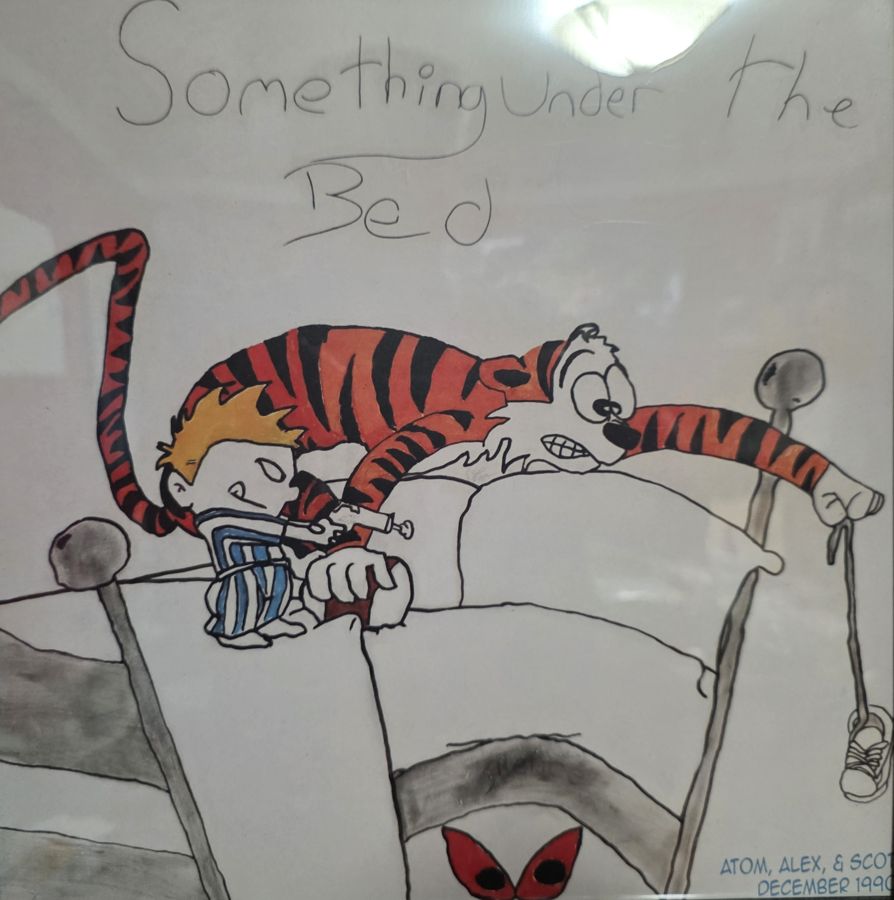
My brothers Adam, Alex, and I loved Calvin and Hobbes as kids. It was one of the only things we universally loved. In fact, it was such a strong bond that it inspired the only piece of artwork my brothers and I ever made together: an 8 x 10 wall mural of a Calvin and Hobbes strip we loved, which stayed in our parents’ house for over 30 years.
Our mom’s college roommate had started us on it, much to our parents’ frustration, because we immediately started using it as material. I used to regularly mimic Calvin as a faux political commentator, telling my father his approval rating was down. Adam loved the strip where Calvin is riding in the back of his parents’ car and holds up a sign in the rear window that says, “Help, I’m being kidnapped.”
Adam thought this was the funniest thing he’d ever read. One day, my father was out running errands and Adam was in the back of the old red Ford Country Squire, the one with the fold-up seats facing backward. He waited until they were moving and stuck his handwritten HELP, I’M BEING KIDNAPPED sign to the window.
Where the story always split
It only took a few minutes for my father to get pulled over. But here’s where the story always split. In Adam’s version, the whole thing was over in thirty seconds. The cop knew my father, everybody laughed, the cop told Adam not to do it again, and they drove home. No big deal. In my father’s version, he was handcuffed and put in the back of the cop car. Depending on how many manhattans he’d had that evening, he may have been roughed up a bit before being released.
On the front porch of my parents’ summer cottage, retelling this story, neither of them ever gave an inch. Every time it came up, they’d go right back at it, Adam insisting it was nothing, my father insisting it was a full-on detainment. What was true probably lived somewhere in between, but that wasn’t really the point. The point was the way they told the story, the way they each held on to their version and refused to let the other one have it, and how much we all laughed every time they did. My kids loved it too, which is why they were not allowed paper and pen in the car when they were younger.
I’d give a lot to hear them have that argument one more time.
Looking for something better
During my father’s final years, and in the years after his death in March 2018, I started exploring ways to keep family stories. I came across platforms for saving records, saving photographs, and even saving stories printed into books. But I wanted something closer to the front-porch storytelling I did with my family, and that we did with my wife’s multigenerational Dominican family, throughout the years. I wanted to hear their voices: how my father did a famously bad impersonation of the cop, and Adam’s high-pitched laugh.
My father lived with dementia for three years before he passed, and he was an only child. I realized only after he was gone how much that narrowed the number of people who could later fill in missing details, or retell the stories I hadn’t captured while he was still healthy and himself. I regretted this deeply.
Around 2020, after exploring a number of options and speaking to other parents navigating the declining health of their own parents, I began to informally map out what a better solution could look like. I named it MiMir, after the Norse god of wisdom and knowledge. I was struck by one question: could technology preserve enough of a person’s authentic voice, stories, wisdom, and personality that current and future generations could experience it in a meaningful way, as more than an archive of disconnected files? In other words, could I build something closer to those front-porch visits? And, if I was really lucky, trigger a lot more of them?
A fire lit
In 2021, my youngest son, Maxim, was diagnosed with a rare and aggressive cancer. That same year, my brother Adam died suddenly. Three years later, my mom passed away, also suddenly. Anyone who has lived through seasons of intense grief and uncertainty knows that the first thing you reach for is the people you love: their wisdom, their comfort, their humor. Their stories. It lit a fire in me to bring MiMir to market and preserve as many family stories as I could.
For the whole of life
Maxim’s diagnosis also broadened the way I thought about MiMir. Originally, I saw it as a tool families would mostly rely on after a loss. But I realized how vital it is to recognize and enjoy the value of our experiences while we are still living them. The version we’re bringing to market today is as much for capturing stories from aging parents and loved ones as it is for families who want to capture and revisit their own “Help, I’m being kidnapped” tales: stories from a wedding or a graduation, birthday wishes, or, in the case of my family, a little mocking. Life’s events are always worth capturing. They are, in fact, what makes us, us.
For almost a year now, I have been using test versions of the app to capture parts of our life, especially with Maxim. As so many parents in our situation have learned, this sort of struggle makes every moment of joy that much more precious. Those moments help you focus on the good when there is so much bad, and they let you relive the good times on days filled with suffering.
This is what I imagine the purest and most meaningful version of a social network to be: the recounting and saving of our experiences, and the connections that grow stronger over time through what we share with one another. Just in a safe space, without ads, algorithms, or data monetization, where the only goal is strengthening the bonds between the people we love, whether they are with us right now or not.
The address is nothing without the story
There’s a concept in philosophy called qualia: the subjective, first-person quality of an experience that can’t be fully conveyed to anyone who hasn’t had it. It’s the redness of red, or the specific feeling of cold water.
I’ve come to believe that experiencing people is like this, too. We can keep pictures of them, and know how they take their coffee, their favorite movie, or their childhood address, but none of that gives us the same feeling as hearing their stories as they experienced them, told in their own voices. My kids have been to the house we grew up in, and it is nothing like the Salvador Dalí painting my brothers and our friends would describe. When it comes to childhood, the address is nothing without the story.
MiMir captures these stories for families across generations, with the pauses, the humor, and the wisdom, all exactly as they were meant. It’s a snapshot of who people were when they were most themselves, at 15, and 34, and 79. Families can capture stories on their own front porch, in the living room, or elbow to elbow around a table. And then, whenever someone they love wants to hear that story, and that voice, all they have to do is press “play.”
Founder, MiMir